

Modern healthcare organizations operate in an increasingly complex financial environment, where rising patient financial responsibility, stricter payer requirements, and automated insurance solutions make revenue management more challenging than ever. In clinics and hospitals, effective financial management is critical to maintaining stability, as even small inefficiencies can lead to significant revenue loss.
Common challenges such as claim delays, denials, manual errors, and inaccurate data entry continue to disrupt the billing process and create revenue leakage across healthcare systems. These interlinked issues make it complex for healthcare organizations to sustain steady financial performance.
This is where revenue cycle management (RCM) plays a vital role. RCM serves as a structured solution that streamlines billing, coding, claims processing, and collections. It connects clinical services directly with financial outcomes, ensuring that every patient interaction is accurately captured and efficiently converted into revenue.
What is Revenue Cycle Management in Healthcare?
Revenue cycle management (RCM) is the end-to-end financial process that governs how healthcare providers capture, manage, and collect revenue for services delivered to patients. RCM covers the full patient financial journey, from the moment a patient schedules an appointment through registration, eligibility verification, clinical documentation, charge capture, coding, claim submission, payer adjudication, payment posting, denial management, and final patient balance collection.

In practice, the revenue cycle is not a linear process but a connected financial solution where each stage impacts the next. Errors in early steps, such as patient registration or eligibility checks, can lead to claim denials, delays, and increased administrative costs later in the cycle. Revenue cycle management (RCM) plays a critical role in healthcare organizations by ensuring financial stability and operational efficiency. It is used across the industry, including hospitals, clinics, and private practices, to manage reimbursements and maintain consistent cash flow.
Revenue cycle management (RCM) is one of the most important aspects of healthcare operations, as it reduces inefficiencies, minimizes revenue leakage, and streamlines financial workflows to help healthcare providers maintain stronger financial performance and operational stability.
10 Key Steps in Revenue Cycle Management (RCM) Process
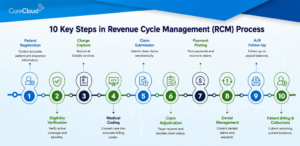
1. Patient Registration
It is the fundamental stage of the revenue cycle management (RCM) process, where all insurance, demographic, and contact information are gathered before care delivery begins. This stage instantly influences the value of downstream billing results. Precise insurance validation, demographic precision, or patient identity are crucial because any discrepancy here propagates into delayed reimbursement or claim rejection in the cycle.
From a financial standpoint, patient registration represents the first control point for revenue integrity. Errors at this stage often lead to claim denials that require expensive rework or complete resubmission, increasing administrative cost per claim significantly.
In 2026, leading organizations are increasingly relying on automated intake systems, real time data validation, and EHR integrated registration workflows to reduce human error. Within advanced revenue cycle management (RCM) solutions, patient registration is no longer a manual administrative task, but an automated verification process that ensures clean data flow into billing systems.
2. Insurance Eligibility Verification
Insurance eligibility verification ensures that a patient’s coverage is active, and that services planned are reimbursable under their payer’s plan. This step has become financially critical due to the rise of high deductible health plans and more restrictive payer policies. When eligibility is not verified upfront, providers face higher rates of denied claims and increased patient responsibility balances.
A failure in eligibility verification leads to immediate revenue disruption. Claims may be rejected due to inactive coverage, incorrect payer information, or unmet plan requirements. Modern healthcare billing workflow solutions now use real time eligibility checks integrated directly into scheduling and intake platforms. This reduces manual verification delays and improves first pass claim acceptance rates.
Integrated platforms incorporate eligibility verification into the front end of the medical billing process, ensuring that financial risks are identified before services are delivered rather than after claims are submitted.
3. Charge Capture
The process of documenting all billable clinical services delivered throughout patient care is referred to as charge capture. When clinical services are not properly captured, they end up in immediate revenue loss and cannot be billed.
Today, charge capture failure is one of the major sources of unseen revenue leakage in healthcare ecosystems. Reimbursement per patient encounter can be reduced by missing procedures, delayed charge entry, or undocumented services.
Automated charge capture systems in 2026, integrated with electronic health records (EHR), are gradually used to minimize dependency on manual entry. These systems ensure that clinical documentation automatically translates into billable events, improving accuracy, and reducing missed revenue opportunities.
4. Medical Coding
It is the procedure of transferring clinical documentation into consistent billing codes, for example, CPT, ICD-10, and HCPCS. Payer reimbursement completely relies on coding accuracy, which is why it is important. Claim denials, compliance audits, or underpayments can also be the result of these minor errors.
Inaccurate coding not only delays reimbursement but can also trigger regulatory risk exposure under CMS and payer audit frameworks. As healthcare shifts toward value-based care models, coding accuracy is becoming even more important for quality-based reimbursement alignment.
Modern RCM solutions that incorporate specialized medical coding services increasingly rely on AI-assisted coding validation tools to reduce human error, improve compliance, and support accurate claim submissions.
5. Claim Submission
Claim submission involves preparing and transmitting coded claims to insurance payers through electronic clearinghouses. This stage determines how quickly revenue enters the reimbursement pipeline. Clean, error free claims significantly improve payment speed and reduce rejection rates.
Failures in claim submission often occur due to formatting errors, missing data fields, or mismatched coding structures. These errors delay processing and increase administrative workload.
In 2026, automated claim scrubbing tools and EDI based submission systems are standard across advanced billing platforms. Integrated systems enhance submission accuracy by validating claims before transmission, reducing rejections, and improving first pass acceptance rates.
Claim Rejection vs Claim Denial
| Aspect | Claim Rejection | Claim Denial |
| Stage in workflow | Front-end clearinghouse validation | Post-adjudication payer decision |
| Processing status | Claim never enters payer system | Claim processed but not paid |
| Common causes | Formatting errors, missing data, invalid codes | Eligibility issues, coverage limits, medical necessity |
| Correction effort | Low (fix and resubmit clean claim) | High (appeal or resubmission required) |
| Revenue impact | Delayed cash flow | Direct revenue loss risk |
| Industry RCM best practice | Clean claim scrubbing before submission | Denial prevention + automated denial management workflows |
6. Claim Adjudication
Claim adjudication is the process where insurance payers review submitted claims and determine approval, denial, or request additional information.
This stage is heavily influenced by payer specific rules, contractual agreements, and regulatory requirements. The outcome of adjudication directly determines final reimbursement amounts.
When claims are denied or partially approved, it increases downstream workload and delays revenue realization. Automation in adjudication prediction is becoming increasingly important in modern revenue cycle management process systems.
Claim Adjudication Outcomes
| Outcome | Meaning | Revenue Impact |
| Approved | Claim accepted as submitted | Full or partial reimbursement received |
| Denied | Claim not payable by payer | Requires appeal or resubmission; revenue risk |
| Pending / Additional Info Required | Payer requests documentation | Delays reimbursement cycle |
| Partially Paid | Only part of claim reimbursed | Revenue gap requiring follow-up |
7. Payment Posting
Payment posting involves recording insurer and patient payments into the billing system and reconciling them with submitted claims.
This step ensures financial transparency and accuracy in revenue reporting. Incorrect posting can lead to inaccurate financial statements and distorted revenue forecasting.
Automation in payment posting, including electronic remittance advice processing, is widely used in modern systems to reduce manual reconciliation errors.
8. Denial Management
Denial management is the stage where the platform identifies rejected or denied claims, finding out the root cause behind them and making sure they are accurate to be resubmitted. This is one of the most crucial stages out of them all, as it can slow down the reimbursement flow and increase the time to recover payments.
The common reasons behind claim denials include coding errors, incorrect patient eligibility information, modifier or bundling issues, and missing prior authorizations. If not resolved in a timely manner, denials can increase administrative burden and accounts receivable (A/R) aging for billing teams.
In modern revenue cycle management process systems, denial management workflows are often integrated with billing software to track denial patterns, flag recurring payer issues, and support faster claim correction and resubmission. This helps healthcare organizations reduce preventable denials and maintain more consistent reimbursement cycles.
9. Accounts Receivable Follow Up
Accounts receivable (A/R) follow up focuses on tracking unpaid claims and ensuring timely reimbursement from payers.
Delayed accounts receivable (A/R) cycles reduce cash flow stability and increase financial uncertainty. Organizations with poor account receivable (A/R) performance often struggle with liquidity issues even when revenue volume is high.
Automation tools now prioritize aging claims, flag high risk accounts, and trigger escalation workflows to improve recovery timelines.
10. Patient Billing and Collections
Patient billing and collections involve invoicing patients for remaining balances after insurance payments have been applied. With rising deductible plans, patient responsibility now represents a significant portion of healthcare revenue.
Inefficient patient billing communication can lead to delayed payments and increased bad debt. Modern medical billing services use automated reminders, flexible payment plans, and digital billing portals to improve collection efficiency while enhancing the patient’s payment experience.
Importance of Revenue Cycle Management (RCM)
A well optimized revenue cycle management (RCM) process ensures:
- Stable and Predictable Cash Flow
- Reduced Revenue Leakage Across All Stages
- Improved Billing Accuracy and Compliance Alignment
- Lower Claim Denial Rates
- Increased Operational Efficiency
- Better Financial Transparency and Reporting Accuracy
In modern healthcare systems, revenue cycle management (RCM) is no longer optional. It is the foundation of financial sustainability, operational efficiency, and long-term sustainability.
Conclusion
In 2026, modern RCM solutions run as an interlinked financial network where organizational stability and revenue integrity are directly influenced by each individual stage of RCM processes. Healthcare practices accomplish more powerful cash flow, enhanced financial predictability, and reduced administrative burden when patient access, claims processing, denial management, coding, and collections run as a single system.
CareCloud’s platform supports providers to revamp the whole medical billing workflow, enhancing financial performance outcomes, minimizing inefficiencies with the help of unified workflows and automation. In an increasingly complex healthcare environment, effective RCM results in smoother operations, long-term sustainability, and better financial health.
Learn more about automated RCM Solution ❯
Frequently Asked Questions
1. How does automation improve the revenue cycle management process?
Automation improves the revenue cycle management (RCM) process by reducing manual errors, enhancing eligibility verification, optimizing payment posting, speeding up claim processing, and supporting faster reimbursement cycles with increased operational efficiency.
2. What is the average revenue cycle timeline in healthcare?
Typically, a healthcare revenue cycle timeline ranges between 30 to 60 days, and it may vary depending on denial rates, payer responsiveness, and claim complexity.
3. Why is RCM important for healthcare organizations?
Revenue cycle management (RCM) is important because it helps healthcare organizations maintain stable cash flow, reduce revenue leakage, improve billing accuracy, strengthen financial visibility, and support long-term operational sustainability.
4. Should healthcare providers outsource RCM?
Yes, outsourcing revenue cycle management (RCM) can help healthcare providers improve claim accuracy, reduce administrative burden, lower denial rates, and access specialized billing expertise.
5. What are the most important RCM KPIs?
The most important revenue cycle management (RCM) KPIs include:
- Days in Account Receivable (A/R)
- Clean Claim Rate
- Denial Rate
- Net Collection Rate
- First Pass Resolution Rate
- Cost to Collect